


Vietnam tourism 2026: Third consecutive month with over 2 million international visitors
Mar 9
4 min read
The latest statistics released by the General Statistics Office (Ministry of Finance) show that international arrivals to Vietnam exceeded 2.2 million in February 2026. Previously, Vietnam welcomed 2.45 million visitors in January 2026 and 2.02 million in December 2025.

In February 2026, international arrivals declined by 9.2% month-on-month but increased by 17.7% year-on-year compared with the same period in 2025. Overall, in the first two months of 2026, Vietnam received approximately 4.68 million international visitors, representing a 17.7% increase year-on-year.
Among them, arrivals by air reached over 3.8 million, accounting for 81.8% of total international visitors, up 12.8% year-on-year. Meanwhile, arrivals by land totaled 741,200 visitors, while sea arrivals reached 109,500 visitors.

International visitors to Vietnam by month in 2025 and the first two months of 2026 (thousand arrivals), Source: Vietnam National Authority of Tourism
Alongside the increase in visitor numbers, tourism and travel service revenue in the first two months of 2026 is estimated at around VND 15 trillion, accounting for 1.2% of total retail sales of goods and consumer service revenue, and representing a 12.2% increase year-on-year. This result has been driven by the strong rebound in domestic tourism as well as the rising number of international visitors arriving in Vietnam at the beginning of the year.
An analysis of the international visitor market structure in the first two months of 2026 continues to highlight the dominant role of nearby Asian markets. Total arrivals from Asia reached approximately 3.4 million visitors, accounting for 73% of all international arrivals to Vietnam during the period.
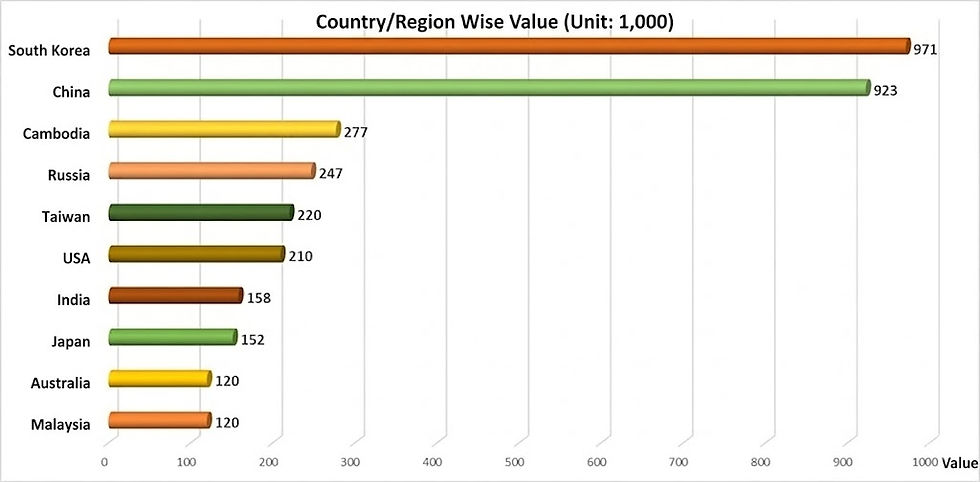
Top 10 source markets in the first two months of 2026 (thousand visitors). Source: Vietnam National Authority of Tourism
Notably, South Korea has once again emerged as Vietnam’s largest inbound tourism market, with approximately 971,000 visitors in the first two months of the year, up around 10% year-on-year. This market not only maintains a large visitor base but also demonstrates stable growth, reflecting the sustained attractiveness of Vietnam’s beach resort tourism, golf tourism, family travel, and the advantage of dense air connectivity between the two countries.
China ranked second, with approximately 923,000 visitors. Meanwhile, Japan and Taiwan continued to record steady growth, reinforcing the importance of Northeast Asia as a major source region for Vietnam’s international tourism market.
In addition to traditional markets, India has emerged as a high-potential new source market with strong growth momentum. In the first two months of 2026, Vietnam welcomed around 158,000 Indian visitors, representing an increase of more than 71% year-on-year. The rapid growth of this market highlights the effectiveness of Vietnam’s strategy to diversify international visitor sources, particularly as direct flight connections between the two countries continue to expand.
In long-haul markets, Europe continues to stand out as a key growth driver, with 847,000 visitors in the first two months of 2026, representing a 67.4% increase year-on-year. Major markets such as the United Kingdom (+17.1%), France (+19.8%), and Germany (+17.5%) recorded strong growth. Notably, Russia remained the largest European source market, with 247,000 visitors, surging 212.5% year-on-year. European travelers typically stay longer and spend more, contributing significantly to the overall economic value of Vietnam’s tourism sector.
Amid intensifying global competition among travel destinations, Vietnam’s tourism industry is being supported by an increasingly clear combination of growth drivers, enhancing both its competitiveness and attractiveness to international visitors.
First and foremost, Vietnam’s stable and safe socio-political environment continues to serve as a fundamental advantage. As international travelers increasingly prioritize safe and accessible destinations, Vietnam’s image as a friendly and stable country has helped strengthen market confidence and influence destination choices.
At the same time, tourism promotion and marketing activities are shifting toward a more professional, digitally driven approach with stronger public–private collaboration. Leveraging digital platforms, expanding cooperation with airlines, technology companies, and international partners, and enhancing destination marketing campaigns are helping Vietnam broaden its global reach, access target visitor segments, and improve the effectiveness of tourism promotion.

Service quality has also shown notable improvements. Many businesses have proactively restructured operations, accelerated the adoption of digital technologies, enhanced service standards, and developed specialized products tailored to different market segments. From an infrastructure perspective, the expansion of transportation networks—particularly international air connectivity—continues to create additional growth momentum for the tourism sector.
However, the ongoing Middle East crisis is exerting increasing pressure on global aviation, trade, tourism, and supply chains. The Civil Aviation Authority of Vietnam (CAAV) recently submitted a report to the Ministry of Construction assessing the potential impacts of the conflict on Vietnam’s civil aviation industry.
Flights connecting through or transiting major Middle Eastern hubs such as Dubai, Doha, and Abu Dhabi have been affected as passengers grow increasingly concerned about airspace safety. High-end tour packages from Vietnam to the Middle East—typically priced at VND 100–130 million—have already been completely canceled.
At the same time, flights from Vietnam to Europe, North America, and Africa via the Middle East have declined, forcing passengers to choose alternative routes through Southeast Asia and Northeast Asia transit hubs. This shift is expected to push up airfares, as Vietnam and other countries in the region may struggle to quickly increase capacity to meet sudden demand.
Currently, no Vietnamese airline operates direct routes to the Middle East. Nevertheless, Vietnam Airlines has had to completely adjust its flight routes to Europe to avoid the airspace of Iran, Iraq, and the surrounding areas.
Flights are now required to use either a northern corridor (via Central Asia/China) or a southern corridor (via South Asia and the Arabian Peninsula), extending flight time by approximately 10–15 minutes per flight. This adjustment is estimated to increase operating costs by around USD 2,000 per flight.
In addition, if the conflict escalates further, Vietnam Airlines may face higher war risk insurance premiums, estimated to increase by 10–15% for aircraft operating on intercontinental routes near conflict zones.
So far, due to the impact of the conflict, airlines have canceled 23 flights carrying nearly 6,000 passengers between February 28 and March 2.
According to VnEconomy
Source: https://vneconomy.vn/viet-nam-don-tren-2-trieu-luot-khach-quoc-te-thang-thu-3-lien-tiep.htm


Comments